A Litecoin address is a human-readable representation of a payment destination or spending condition. Its appearance can give you a useful clue about format and network, but a prefix is not a complete safety check. A correctly shaped address can still be the wrong recipient, and an unsupported wallet can reject a valid format. The most reliable workflow combines format validation with careful confirmation of the destination and receiving instructions.
This guide explains common Litecoin mainnet address families and the limits of address-based explorer views. It does not ask you to enter an address, connect a wallet, or expose any spending secret. Use the concepts here to understand what your wallet and the address detail page actually display.
Address, wallet, and private key are different
An address is not the wallet itself. A wallet can manage many destinations and the information needed to spend associated outputs. A private key or recovery phrase is sensitive spending material; an address is designed to be shared as a receiving destination. Confusing those categories creates avoidable risk when asking for help or using an unfamiliar website.
A support conversation about a payment may need a public address and transaction identifier. It does not need your recovery words. Likewise, an explorer does not need to connect to your wallet to inspect a public transparent transaction. Keep those boundaries firm even when a page imitates a familiar brand or claims that an urgent synchronization step is necessary.
Recognize common mainnet families
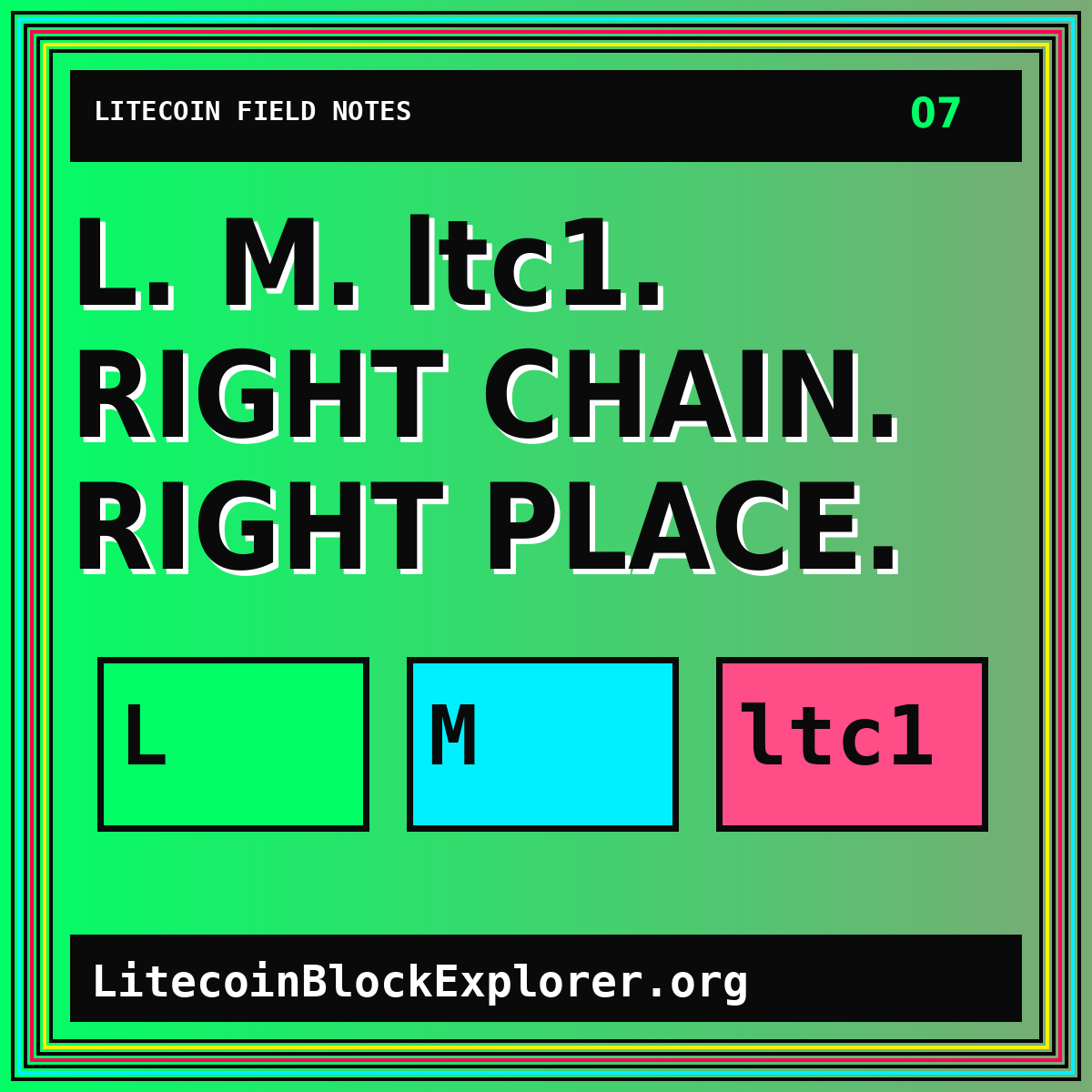
Common transparent Litecoin mainnet addresses include legacy forms beginning with L, script-hash forms often beginning with M, and native SegWit forms beginning with ltc1. Older script-hash representations beginning with 3 also exist and can be confusing because that prefix appears in other contexts. These are useful orientation cues, not a substitute for full decoding and network checks.
Litecoin's address-encoding implementation handles supported destination encodings and validation. Format rules involve more than the first character. Length, payload, checksum, witness version where applicable, and network parameters all matter. Do not decide that an address is valid merely because it starts with letters you recognize.
The network must match at both ends
A sender and recipient need to agree on the network, not only the asset's displayed name. A wallet or service can list several networks or representations under similar branding. Native Litecoin should be sent using instructions that actually support Litecoin mainnet. An address-looking string supplied for another system does not become compatible because a user expects to send LTC.
Before sending, read the receiving page's network label and restrictions. When working with a new service, keep a record of the instructions it gave you. A mistaken network choice can create a problem that no block explorer can reverse. The native LTC guide explains why native coins and similarly named tokens on other chains must be identified separately.
A checksum does not verify the recipient
Address encodings include mechanisms intended to detect certain transcription errors. Those checks help catch malformed strings, but they do not authenticate the person or service that supplied an address. A malicious destination can be perfectly valid. A clipboard substitution can also replace one valid destination with another valid destination.
Confirm the destination through a trusted channel and compare the full address in the sending interface before authorizing a payment. Do not rely only on the first and last few characters when the consequences are significant. A visually similar string or familiar prefix is weak evidence. The distinction is between syntax validation, which checks form, and recipient verification, which checks whether this is the destination you intended.
Wallet support is an operational question
A valid address format may not be supported by every wallet, exchange, or payment service. Support can depend on software versions and the type of transfer being attempted. An application's refusal to accept a destination does not automatically prove that the address is fraudulent. It may indicate a compatibility limitation that needs to be resolved through that application's documentation.
Do not manually rewrite prefixes or transform an address using an untrusted online tool to force a transaction through. Such changes can be wrong even when the result looks plausible. Use a receiving format explicitly supported by both ends, following authenticated wallet or service instructions. If a service has maintenance or feature restrictions, address validity alone does not override those restrictions.
One address is not a complete wallet balance
Wallet software can generate fresh receiving addresses and separate change destinations. An explorer's balance for one transparent address therefore need not match the wallet's total. It may represent only a small portion of the wallet's outputs. Conversely, an exchange may use shared infrastructure that does not map neatly to a single customer's account balance.
When comparing figures, identify the scope: one address, a set of wallet-controlled outputs, or a private service account. Also distinguish historical received value from currently unspent value. A large lifetime received total does not mean the same amount remains available now. The UTXO guide explains how outputs are created and later consumed.
Address reuse changes what observers can connect
Using the same transparent address repeatedly can make separate payments easier to associate with one destination. That does not automatically reveal a legal identity, but it can expose relationships that were less obvious when viewed separately. Sharing an address alongside your name, invoice, or social profile can add further context to the public record.
Think about what information you publish with a payment request. A screenshot may expose other transactions, balances, or account details beyond the one payment you intended to discuss. When seeking support, share only the identifiers needed to investigate. A public address is not a private key, but that does not make every use of it privacy-neutral.
MWEB requires a separate mental model
MWEB-related destinations and records should not be treated as ordinary transparent address history. Privacy-oriented transaction features can limit what a general explorer can display. A provider that supports common transparent address balances may not support the relevant MWEB view. Absence of a familiar history table does not justify inventing a zero balance.
This site keeps that limitation explicit. It does not claim to reveal confidential MWEB amounts or reconstruct a complete private transaction trail. Consult the MWEB visibility guide for the distinction between public chain information, wallet-held information, and unsupported explorer fields. The correct response to limited visibility is to explain the limit, not to market a fictional decryption capability.
Investigate an address mismatch step by step
Suppose the destination displayed in a transaction is not what you expected. First compare the exact string with the receiving instructions saved before sending. Confirm the network and whether the explorer is showing the relevant output rather than an input or change output. A transaction can contain several destinations, so the first address on the page may not be the recipient.
If the actual payment output differs from the intended destination, stop and investigate through trusted wallet or service support. Preserve the transaction identifier and original instructions. Do not send a second payment merely because an unsolicited message claims it will “correct” the first. A block explorer reports the resulting transaction; it cannot change its destination after confirmation.
Understand the limits of ownership labels
Some explorers attach organization names to addresses. Such labels can be based on public statements, analytical inference, or submitted information. Their reliability varies, and an attribution may cover only a particular period or operational arrangement. Treat a label as a claim with a source, not as a consensus field authenticated by the blockchain.
For a payment dispute, the exact destination and transaction evidence are more useful than an unverified label. For research, retain uncertainty and avoid making accusations about people from a single address association. Even when an organization controls an address, a transfer involving it does not automatically disclose the identity or intent of an individual customer using that organization.
Conclusion: validate form and verify context
Address prefixes help you recognize common Litecoin formats, but they do not answer every safety question. Check the network, full encoding, recipient, and wallet compatibility. Keep public identifiers separate from spending secrets, and remember that one address is not necessarily a complete wallet or customer account.
Use the learning hub to connect address concepts with transaction outputs and confirmations. A destination becomes meaningful only in context: which network it belongs to, which output pays it, and whether it is the address you actually intended to use.