Litecoin, Dogecoin, and AuxPoW: Merged Mining Explained
Learn how Litecoin mining relates to Dogecoin’s auxiliary proof of work without confusing the two ledgers.
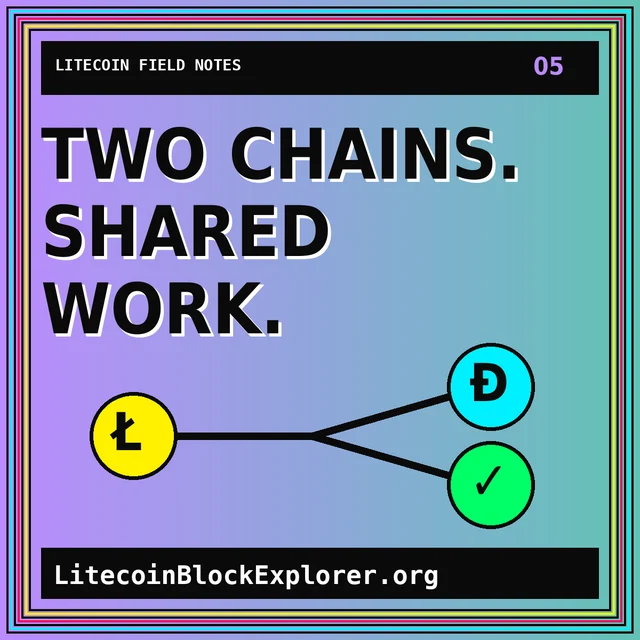
Read the field note · 7 minLitecoin uses Scrypt proof of work. Dogecoin can validate auxiliary proof of work. Merged mining connects compatible work—not the two transaction ledgers.
“Litecoin Scrypt AuxPoW” is a useful search phrase, but the terms describe different parts of the relationship. Scrypt is Litecoin’s proof-of-work algorithm. Merged mining can coordinate compatible work across chains. AuxPoW is the auxiliary proof checked by a supporting chain, such as Dogecoin, under that chain’s rules.
Dogecoin’s AuxPoW implementation validates structural links between an auxiliary block and the associated parent-work evidence. That is not a statement that Litecoin itself validates Dogecoin-style auxiliary proofs. Litecoin continues to apply its own consensus requirements.
A Litecoin block hash and a Dogecoin block hash identify different records. Their heights, transactions, and confirmation counts belong to different chains. Use the explorer appropriate to the actual asset and network involved in a payment.
A profit-switching arrangement moves work between opportunities. Merged mining can use coordinated work for compatible chains simultaneously. A service advertising multiple payout currencies might also convert proceeds, so a payout label alone is not enough to identify the mining arrangement.
The LitecoinPool FAQ explains merged mining from an operating pool’s perspective. Its accounting and payout details belong to that pool; other services can differ. Check current terms with the service you actually use.
A pool share measures work under a pool’s threshold. A network block meets the relevant chain’s conditions. A payout is a transaction resulting from the pool’s accounting policy. The existence of one does not automatically establish the timing or amount of another.
If a payout is missing, start with the asset, destination, payout schedule, and actual transaction identifier supplied by the pool. Only then use a chain explorer. Do not expect a random Litecoin block to explain the pool’s entire LTC and DOGE accounting history.
This browser reports supported Litecoin mainnet fields from a public provider. It does not infer Dogecoin blocks, AuxPoW commitments, pool ownership, or merged-mining revenue from ordinary Litecoin transaction responses. Unsupported cross-chain data stays unsupported rather than becoming a fabricated statistic.
Read the complete Litecoin and Dogecoin merged-mining guide for worked distinctions, payout troubleshooting, and questions to ask when evaluating mining claims. For block fields themselves, continue to block anatomy.
Learn how Litecoin mining relates to Dogecoin’s auxiliary proof of work without confusing the two ledgers.
Read the field note · 7 minUnderstand mining, validation, difficulty, and the limits of hash-rate measurements.
Read the field note · 7 minBuild a static browser with safe rendering, exact units, caching, pagination, and honest error states.
Read the field note · 7 min