Litecoin Proof of Work: How Scrypt Mining Secures Blocks
Understand mining, validation, difficulty, and the limits of hash-rate measurements.
Read the field note · 7 minUnderstand the difference between finding qualifying work, validating a block, and interpreting a mining statistic.
Litecoin uses Scrypt proof of work. Miners construct candidate blocks and perform repeated computations, while validating nodes check that proposed blocks satisfy the rules. Producing work does not authorize invalid spends or arbitrary issuance. The two responsibilities—proposing and validating—must stay separate in a useful explanation of the network.
The proof-of-work target determines which candidate results qualify. Difficulty changes according to protocol rules rather than a dashboard operator’s preferences. Litecoin Core’s proof-of-work implementation contains the target checks and difficulty-adjustment logic.
A target interval is a statistical goal. Individual block arrivals vary, and a transaction’s inclusion also depends on its circumstances. Avoid treating the time between two recent blocks as a promise about the next one.
Public network hash-rate figures are generally estimates based on observed blocks, difficulty, and a chosen time window. They are not a direct count of every computation performed by every miner. Compare units, observation periods, and estimation methods before concluding that two charts contradict each other.
This website’s live component does not manufacture hash-rate figures from an endpoint that does not provide them. The network view displays only the fields supported by its named provider, with their definitions and limits.
A pool coordinates work and applies an accounting arrangement to participating miners. Accepted shares, network blocks, and wallet payouts are different records. A pool’s payout terms determine when and in which supported assets a participant receives funds. A block explorer cannot reconstruct every internal pool calculation from a single block.
For an operational description of shares and algorithm compatibility, consult the LitecoinPool mining FAQ. Its service terms are specific to that provider and should not be generalized to every pool.
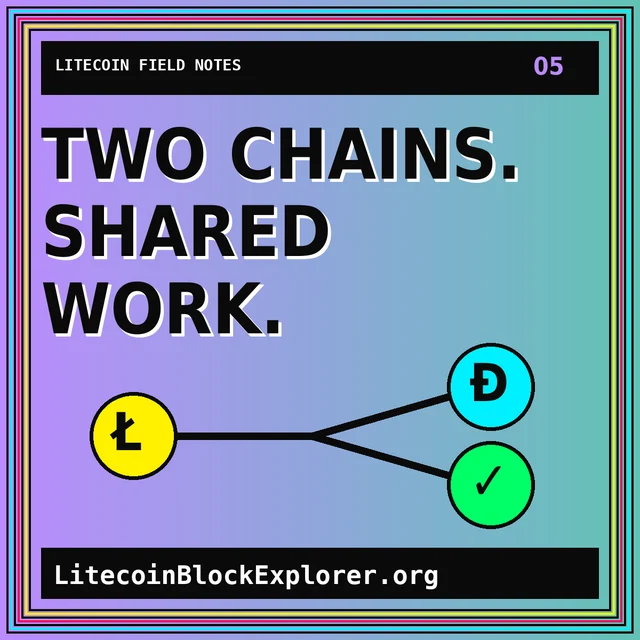
Compatible Scrypt mining work can participate in merged-mining arrangements. Dogecoin supports auxiliary proof of work under its own validation rules. Litecoin does not become a Dogecoin-style AuxPoW chain merely because a pool mines both. Visit the Scrypt and AuxPoW overview for a careful explanation of shared work and separate ledgers.
The full proof-of-work field note also covers block rewards, accumulated work, and why mining statistics should not be turned into absolute security or profitability promises.
Understand mining, validation, difficulty, and the limits of hash-rate measurements.
Read the field note · 7 minLearn how Litecoin mining relates to Dogecoin’s auxiliary proof of work without confusing the two ledgers.
Read the field note · 7 minMake sense of block height, hashes, timestamps, transaction counts, and derived measurements.
Read the field note · 7 min