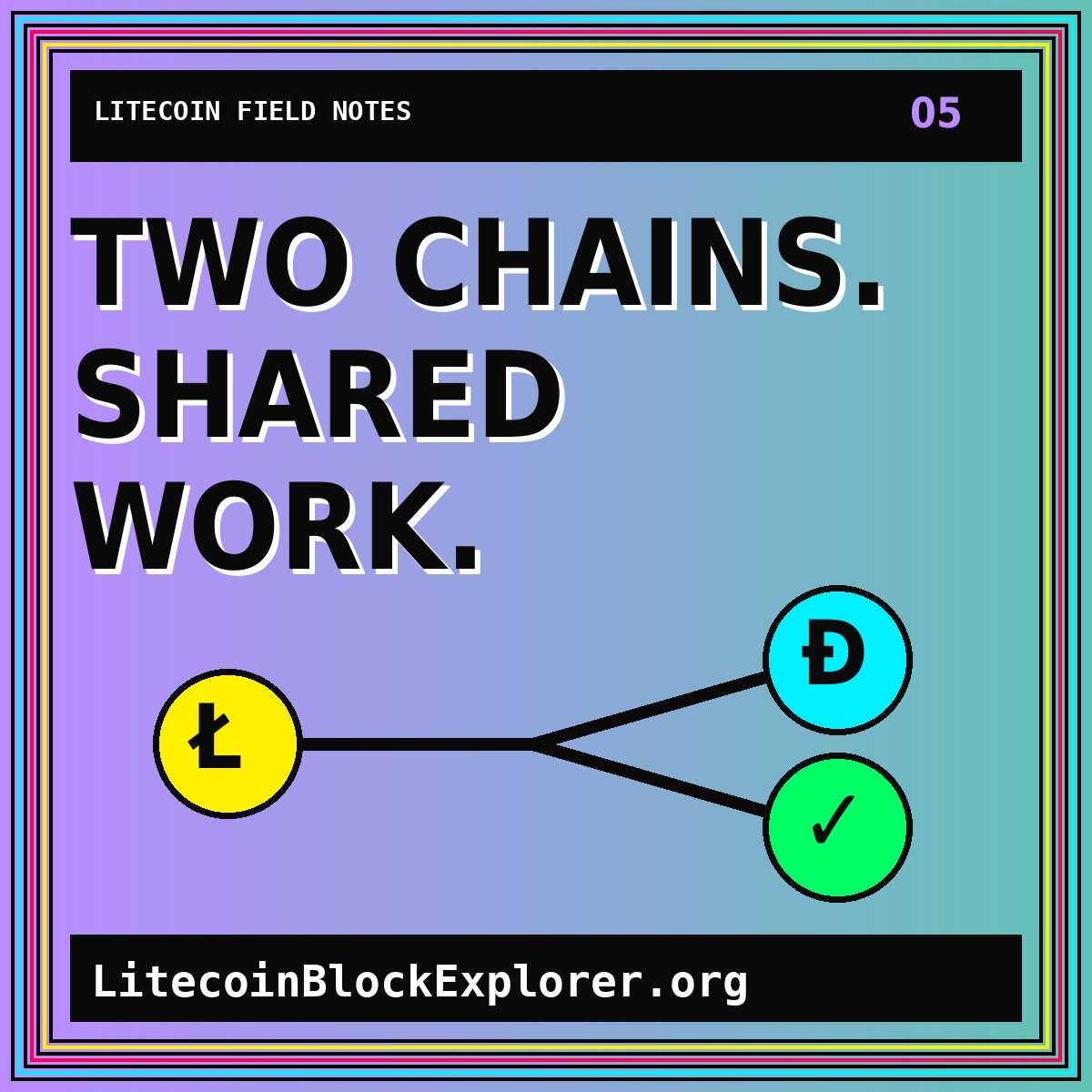
“Litecoin Scrypt AuxPoW” brings together three related ideas that should not be collapsed into one. Litecoin uses Scrypt proof of work. Compatible chains can participate in merged mining. Dogecoin can validate auxiliary proof of work, allowing appropriately constructed work associated with a parent chain to support its own blocks. The chains remain separate, with separate transactions, ledgers, and rules.
That distinction matters for both miners and explorer users. A Litecoin block does not automatically represent a Dogecoin payment, and a merged-mining label does not convert LTC into DOGE. This guide explains the relationship at a conceptual level and shows how to avoid common errors when comparing mining records across the two networks.
Start with two independent ledgers
Litecoin and Dogecoin record different sets of transactions. An address, transaction identifier, or block height on one network should not be assumed to identify the corresponding object on the other. Even when mining work is related, a payment must still be verified on the network where it occurred. Shared work is not shared ownership of funds.
Imagine two separate books of records whose publishers can reuse part of a production process. The process can be coordinated without turning the books into a single book. That analogy is imperfect, but it captures the operational distinction: Litecoin confirmations do not become Dogecoin confirmations, and a Dogecoin explorer does not replace the Litecoin transaction browser for examining an LTC payment.
What auxiliary proof of work establishes
AuxPoW is short for auxiliary proof of work. At a high level, an auxiliary chain checks evidence linking its candidate block to qualifying work in a parent-block structure. The details include commitments and proofs that connect the relevant records. Dogecoin's AuxPoW validation implementation checks the linkage and structural conditions rather than simply trusting a miner's assertion.
The crucial direction is that the auxiliary chain accepts that form of evidence under its own rules. It is misleading to describe Litecoin itself as using Dogecoin-style AuxPoW validation merely because a pool merge-mines both. Litecoin still applies its own block-validation requirements. The relationship changes how compatible mining work can be used, not the identity of the chains.
Merged mining is not profit switching
Profit switching moves mining capacity between opportunities. Merged mining can coordinate work for compatible chains at the same time. These are different arrangements, even when both appear in a pool's marketing language. A miner should not infer the operational model from a vague phrase such as “multi-coin rewards.”
For explorer readers, this distinction prevents a common misinterpretation. A pool reporting activity on multiple chains does not necessarily mean its machines stopped working on Litecoin each time another chain produced a block. Conversely, a pool offering several payout currencies may be converting proceeds rather than directly paying every mined asset. The payout label alone does not reveal the underlying mining or conversion process.
Different targets can produce different outcomes
The relevant chains have their own proof requirements and block candidates. A piece of work can be evaluated in relation to more than one target, but that does not mean every submitted share becomes a network block everywhere. Pool shares, parent-chain blocks, and auxiliary-chain blocks are distinct categories of evidence.
A hypothetical worker may submit many shares that meet a pool's reporting threshold without finding a full network block. Some qualifying work may satisfy one network's conditions while not satisfying another's. The exact implementation handles those distinctions. Avoid expecting a one-to-one pairing between every Litecoin block in an explorer and every Dogecoin block produced by the same pool during an interval.
A share is not a confirmed payment
Pools use shares to measure contributed work under their accounting rules. An accepted share tells you something about work submitted to the pool, not that a corresponding reward has already reached your personal wallet. Payouts depend on the pool's reward method, thresholds, schedule, and account configuration.
This creates three useful layers to track separately: worker activity, pool accounting, and on-chain payouts. If your worker dashboard shows accepted shares but your wallet has not received a payment, the next question concerns the pool's payout policy. Searching random recent blocks is unlikely to explain that accounting state. Once the pool provides a payout transaction identifier, the appropriate chain's explorer becomes useful.
LTC and DOGE amounts must stay separate
A merged-mining dashboard can place LTC and DOGE figures beside one another, but they are different units. Adding the raw coin quantities together produces a number without a coherent asset meaning. Any combined value needs an explicit conversion rate and observation time, and even then it is a valuation estimate rather than a blockchain amount.
For a fictional payout record, 0.02 LTC and 50 DOGE should remain two asset entries. A pool might instead convert some proceeds and pay a single currency, but that is a pool service decision. Check the actual transaction asset and the terms that explain conversion. Do not interpret an absent DOGE wallet payment as proof that merged mining did not occur, because the payout arrangement may differ.
Explorer fields answer chain-specific questions
On a Litecoin block page, you can inspect Litecoin's block hash, height, included transaction identifiers, and other supported fields. Those records do not by themselves provide a complete report of every auxiliary chain a pool was mining. Some relevant information may require a separate chain's block data or a specialized parser.
Likewise, a familiar pool label is an attribution, not a cryptographic statement about every operational relationship. If a provider does not expose AuxPoW-specific data, the correct label is unsupported or unavailable, not zero auxiliary activity. This site's data methodology keeps provider limitations explicit instead of inventing cross-chain statistics from ordinary Litecoin block responses.
Shared work does not eliminate every risk
Merged mining can change the economic and technical relationship between compatible chains, but it is not a universal security guarantee. Each chain still has implementation rules, network participants, and assumptions. Mining concentration, software failures, and operational dependencies remain meaningful topics even when work is shared.
Be cautious with claims that merged mining makes a chain impossible to attack or gives it precisely the same security as another network. Such statements require much more careful analysis than a list of pool names or a single hash-rate figure. A useful explanation states which mechanism is shared and which responsibilities remain separate. It does not turn a coordination technique into an absolute promise.
Investigate a missing pool payout methodically
Begin with the asset the pool says it paid. Confirm the destination and the pool's actual payout identifier. Then select the correct network explorer and inspect the relevant output. Compare the pool's recorded amount with the on-chain payment, while allowing for any documented accounting or conversion arrangement.
If no payout identifier exists, the issue may still be inside the pool's accounting process. If a transaction exists but the receiving wallet does not display it, investigate the destination, network, confirmation requirements, and wallet synchronization. Do not provide recovery words to pool support. A public payout investigation needs transaction evidence, not spending authority over your wallet.
Ask better questions about mining claims
When a service advertises merged mining, ask which chains are involved, how work is coordinated, how shares are accounted for, and which assets are actually paid. Ask whether published performance figures describe hardware, pool-reported work, or block-derived estimates. Each answer should come with a time window and an explanation of the method.
These questions are useful even when you are not operating a miner. They help you interpret an article, a dashboard, or a claim about network activity without assuming that every colorful graphic represents the same underlying measurement. Technical vocabulary becomes valuable when it makes the boundaries clearer, not when it makes ordinary payout accounting sound mysterious.
Conclusion: shared work, separate rules
Litecoin's Scrypt proof of work and Dogecoin's AuxPoW support are related through merged-mining arrangements, but the networks do not become one ledger. Blocks, transactions, units, and payout policies must still be interpreted in their proper context. A label alone does not prove how a pool operates or whether a particular payment occurred.
Continue with the proof-of-work overview or block anatomy guide to connect these concepts to visible records. The central habit is simple: identify the chain, identify the evidence, and avoid asking one network's explorer to prove something it does not record.